
Workplace Utilization Data for Workplace Planners & Strategists
Design Spaces That Reflect How People Actually Work

Why Workplace Planners and Strategists Are Under Pressure
Workplace planners and strategists are being asked to redesign offices for hybrid work, collaboration, and flexibility - often while reducing footprint and improving employee experience. At the same time, utilization patterns are more variable than ever.
Common challenges include:
Difficulty validating whether spaces are being used as intended
Design decisions driven by surveys, complaints, or outdated studies
Pressure to justify redesigns, renovations, or new space types

The core issue isn’t lack of creativity or strategy - it’s lack of objective behavioral data.
Most planning decisions still rely on:
-
Static utilization studies
-
Booking and reservation data
-
Employee surveys and anecdotal feedback
These inputs don’t reflect how people actually move through and experience space.
InnerSpace gives workplace planners continuous visibility into real space behavior - so strategy and design decisions are grounded in evidence, not assumptions.
The KPIs Workplace Planners and Strategists Own
Workplace planners and strategists are often accountable for KPIs such as:
Space utilization by type and zone
Seat-to-employee ratios
Peak vs. average space demand
Space flexibility and adaptability
Employee experience indicators related to space
ROI on workplace redesign investments
Accurately tracking these KPIs requires insight into how space is actually used over time, not just whether it exists.
Why Traditional Planning Inputs Fall Short
Legacy planning inputs introduce blind spots:
-
Surveys reflect perception, not behavior
-
Booking data reflects intent, not use
-
Manual studies are snapshots that age quickly
-
Anecdotal feedback is biased toward extremes
As a result, planners struggle to:
-
Validate whether new space types are working
-
Understand true demand for collaboration vs. focus
-
Identify persistent bottlenecks and friction points
- Measure the impact of design changes over time
How Workplace Planners Use InnerSpace Data
InnerSpace provides continuous, spatially accurate utilization and movement data using existing Wi-Fi infrastructure. Planners use this data to understand not just occupancy, but behavior.
Workplace planners leverage InnerSpace to:
-
Identify how different space types perform
-
Understand flow, dwell, and congestion patterns
-
Compare intended vs. actual use
-
Inform redesigns, pilots, and change management
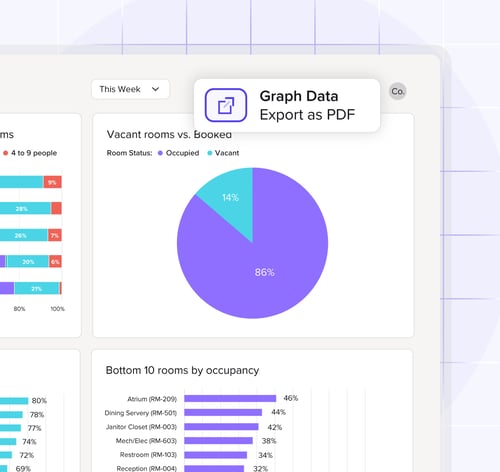
The InnerSpace Data That Informs Planning KPIs
Space Type Performance
Understand how desks, collaboration zones, and focus spaces actually perform.
KEY DATA POINTS:
-
Utilization by space type
-
Dwell time by space type
- Frequency of use vs. availability
KPI IMPACT:
-
More accurate space mix decisions
-
Evidence-based validation of new space types
-
Reduced overbuilding of low-value areas
Peak Demand & Temporal Patterns
Designing for averages hides critical friction on peak days.
KEY DATA POINTS:
-
Peak usage days and hours
-
Daily and weekly demand patterns
-
Variability in demand over time
KPI IMPACT:
-
Better peak-day planning
-
Smarter flexible seating strategies
-
Improved space resilience
Movement, Flow & Bottlenecks
Movement data provides context that occupancy alone cannot.
KEY DATA POINTS:
-
Traffic flow between zones
-
Congestion and bottleneck locations
-
Dwell time in circulation areas
KPI IMPACT:
-
Improved layout efficiency
-
Reduced friction and crowding
-
Better support for collaboration and focus
Intended vs. Actual Use
Validate whether spaces support the behaviors they were designed for.
KEY DATA POINTS:
- Actual use by space purpose
- Frequency of misuse or repurposing
- Comparison across teams or days
KPI IMPACT:
-
Faster design iteration
-
Stronger ROI on redesigns
-
Data-backed change management
Longitudinal Design Impact
Measure whether changes actually work over time.
KEY DATA POINTS:
-
Pre- and post-redesign utilization
- Trend analysis over weeks and months
- Behavioral shifts tied to interventions
KPI IMPACT:
-
Strategic workplace planning and design
The Strategic Role Workforce Analytics Can Play
With reliable utilization data, workforce analytics teams move beyond reporting into strategy:
-
FROM REPORTING → INTERPRETATION: Explaining why patterns exist
-
FROM METRICS → GUIDANCE: Recommending policy or space adjustments
-
FROM DEBATE → ALIGNMENT: Grounding leadership discussions in evidence
InnerSpace enables analytics teams to act as interpreters of workplace behavior, connecting space usage to workforce outcomes across HR, CRE, Facilities, and Finance.
Designed for Modern Workplace Strategy
InnerSpace is:
Continuous and behavior-based
Scalable across buildings and portfolios
Privacy-first and compliance-ready
Built for long-term planning - not one-off studies
Why Workplace Strategists Choose InnerSpace
Design spaces that match real work patterns
Reduce risk in redesign investments
Improve experience without overbuilding
Prove the impact of workplace strategy
Design With Confidence
InnerSpace gives workplace planners and strategists the data foundation needed to design spaces that work - because they reflect how people actually work.
Would you like to see how InnerSpace supports workplace planning and strategy? Fill out the form below and our team would be happy to show you how.