
Most facilities teams rely on:
-
Manual walk-throughs and spot checks
-
Help desk tickets and complaints
-
Booking system availability
-
Historical assumptions about capacity
Anticipate Demand. Reduce Friction. Keep the Workplace Running Smoothly.

Facilities managers are on the front line of return-to-office mandates and hybrid work. When something goes wrong in the workplace - crowded desks, meeting room shortages, bottlenecks, complaints - facilities teams are often the first to hear about it.
The reality is that most facilities issues aren’t caused by lack of space, they’re caused by uneven and unpredictable demand. Without reliable utilization data, facilities teams are forced to guess, react, and absorb frustration from employees and leadership alike.
InnerSpace gives facilities managers a clear, objective view of how space is actually being used - so operations can be proactive instead of reactive.

Facilities managers are often responsible for KPIs such as:
Meeting these KPIs requires understanding when, where, and how demand occurs—not just total headcount.
Most facilities teams rely on:
Manual walk-throughs and spot checks
Help desk tickets and complaints
Booking system availability
Historical assumptions about capacity
These inputs are:
Reactive instead of predictive
Biased toward problem areas
Blind to underutilized space
Unable to show patterns over time
As a result, facilities teams struggle to:
Anticipate peak demand
Justify operational changes
Balance service levels across the week
Explain why issues occur “sometimes but not others”
InnerSpace delivers continuous, anonymized utilization and movement data using existing enterprise Wi-Fi infrastructure. Facilities teams use this data to understand real demand patterns, not just reported issues.
With InnerSpace, facilities managers can:
Identify peak usage days and hours
See which desks, rooms, and zones are under pressure
Spot consistently underused areas
Understand how people move through space
This turns facilities operations from reactive problem-solving into data-informed management.
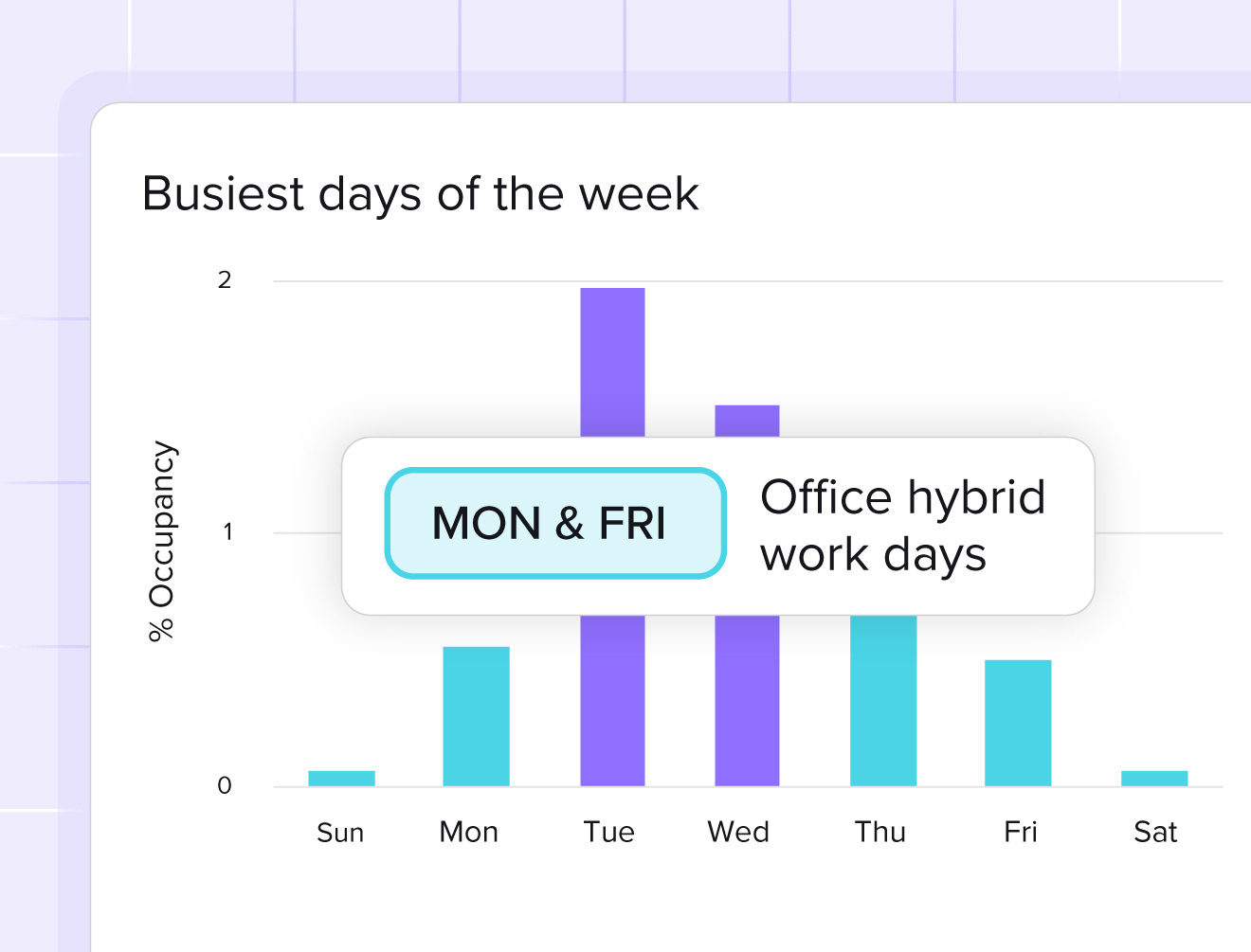
Know where shortages are real and where capacity exists.
KEY DATA POINTS:
Desk and room utilization by day and hour
Peak vs. average demand
Repeat pressure points by location
KPI IMPACT:
Fewer availability complaints
Better desk and room allocation
Improved service levels on peak days
Crowding often happens in predictable places.
KEY DATA POINTS:
Movement paths through buildings
Dwell time in circulation areas
Congestion hotspots
KPI IMPACT:
Reduced bottlenecks
Safer, more comfortable environments
Better support for peak attendance
Not all space is equally valuable.
KEY DATA POINTS:
Persistent underuse by zone or floor
Variability in usage across the week
Empty vs. overused areas
KPI IMPACT:
Opportunities to rebalance demand
Reduced pressure without adding space
More efficient space operations
Facilities' success is often judged on the worst day, not the average.
KEY DATA POINTS:
Peak attendance patterns
Hour-by-hour demand curves
Day-of-week variability
KPI IMPACT:
Better staffing and service planning
Fewer operational surprises
Improved employee confidence in the workplace
Fixing issues once isn’t enough.
KEY DATA POINTS:
Longitudinal utilization trends
Before/after comparisons tied to changes
Repeat problem area tracking
KPI IMPACT:
Continuous improvement
Fewer recurring issues
Data-backed operational decisions
With reliable utilization data, facilities managers move beyond being problem-solvers to becoming trusted operational partners:
FROM REACTING TO COMPLAINT → ANTICIPATING DEMAND
FROM DEFENDING DECISIONS → EXPLAINING THEM WITH DATA
FROM SHORT-TERM FIXES → SUSTAINABLE OPERATIONS
InnerSpace gives facilities teams the visibility they need to operate confidently in dynamic, hybrid workplaces.
InnerSpace is:
InnerSpace gives facilities managers the utilization intelligence needed to keep workplaces running smoothly - no guesswork required.
Would you like to see how InnerSpace supports facilities operations? Fill out the form below and a member of our team would be happy to.